Before AI can transform finance, organizations must fix broken data and process flows. Learn why flow comes first for real AI impact.
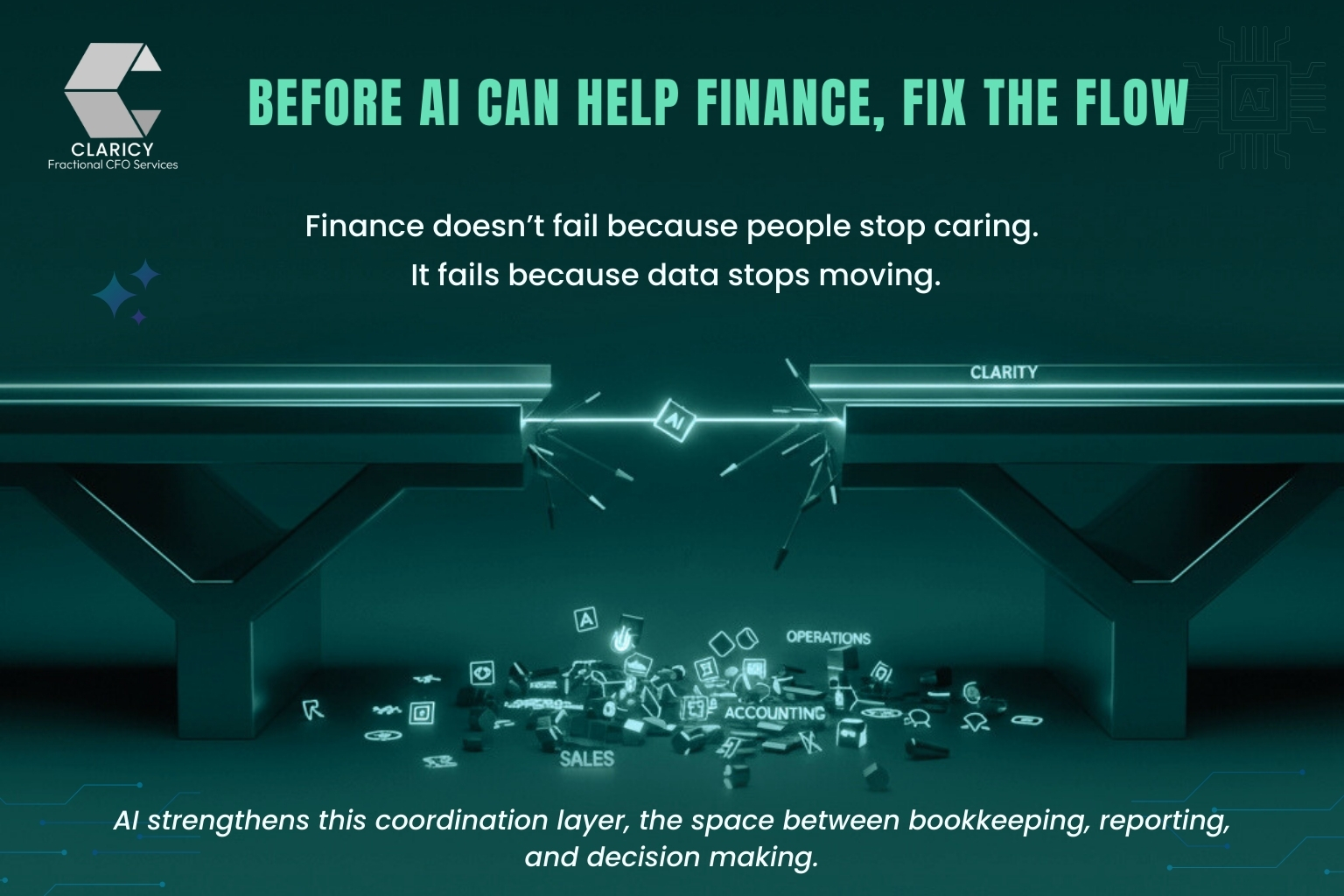
Before AI Can Help Finance, Fix the Flow!
AI can’t connect what your systems never did.
AI isn’t transforming finance overnight, but it is changing what’s possible for growing companies that have long been underserved by traditional finance models.
The story isn’t about automation replacing people.
It’s about finally connecting financial information across sales, operations, and accounting without the cost of enterprise systems or full-time teams.
For years, financial management in small and mid-sized companies has been built on workarounds: disconnected tools, overstretched bookkeepers, and founders trying to make decisions from stale reports.
The problem isn’t effort. It’s structure. And fixing that starts with flow.
1. Financial leadership is shifting ↕️
In many growing companies, there isn’t a full-time CFO. There’s a founder, a part-time bookkeeper, and maybe an external accountant. Yet the need for financial leadership hasn’t gone away. It has increased.
AI now gives fractional CFOs and finance-minded operators leverage. It helps them connect what’s sold, billed, paid, and planned in ways that used to require teams and expensive systems.
The goal isn’t automation for its own sake. It’s clarity and having the information you need to make good decisions, on time, without waiting for someone to piece it together manually.
2. The coordination layer is where change starts 🤝
Finance doesn’t fail because people stop caring. It fails because data stops moving.
AI strengthens this coordination layer, the space between bookkeeping, reporting, and decision-making.
It helps whoever owns that bridge, whether an EA, operations lead, or finance admin, connect receivables, payables, and pipeline into one clear view of financial truth.
That person doesn’t need to be a CPA. What they need is structure, systems, and the right tools. AI can now generate and document repeatable processes that once took weeks to define, freeing human effort for insight instead of rework.
3. The hard truth ✅
Improving financial management in SMBs isn’t about dashboards or another accounting app. It’s about redesigning how finance operates, with scalable fractional expertise, disciplined processes, and technology that fits the stage of the business.
That’s not easy work. It’s hard. Very hard. But it’s possible, and for many, it’s now unavoidable.
You can’t hire your way out of this problem anymore. The cost, availability, and complexity just don’t add up.
Change happens because there’s no other choice. AI, fractional models, and modern systems are giving leaders a new one.
The challenges in SMB finance are well known.
What matters now are solutions: practical, affordable, and repeatable.
Fixing Finance: Practical Systems for Growth-Stage Companies
Most $4M–$20M companies don’t struggle because they lack data.
They struggle because the business has outgrown the informal systems that once held everything together.
As complexity increases, familiar gaps appear:
• Sales and pipeline don’t match delivery
• Delivery doesn’t match billing
• Billing doesn’t match accounting
• Reports lag behind decisions
• Each team has numbers, but none align
This isn’t unusual. It’s the point where clarity depends on the structure underneath it.
1. Connect the core systems before thinking about ERP
After spending 16 years at SAP, one pattern became very clear: ERP creates leverage only when processes and data are already disciplined. Many companies first need clean flow across a few core tools:
Sales → Delivery → Billing → Accounting → Cash → Reporting
When this flow is broken, leaders often believe they “need ERP.”
In reality, ERP only works when the business can sustain the discipline it requires.
2. Establish a finance coordination function
Not a new hire, but a defined function.
Every company has people touching pieces of the flow, but no one is accountable for ensuring that what is sold, delivered, billed, and reported all aligns.
Without this function, every team assumes someone else is keeping the numbers consistent, but no one is.
When accountability is clear, the entire system strengthens.
3. Use automation to remove manual variation
Automation creates stability when the underlying process is clean. It amplifies whatever exists.
High-value areas include:
• Invoicing tied to CRM
• Expense categorisation
• Renewal reminders
• Cash-flow snapshots
• Anomaly or missing-data flags
Used thoughtfully, AI supports these routines without adding more admin work.
4. Shift from reporting to insight
Reporting reflects the systems underneath it.
When the flow is fragmented, reporting becomes fragmented.
Leaders don’t need more dashboards.
They need decision-ready information: Unit economics, margin by service line, capacity vs demand, renewal health, cash runway scenarios.
These insights appear naturally when the system is coordinated.
The inflection point:
Growth doesn’t create chaos. Weak systems do.
When information flows cleanly across the business and teams trust the numbers, finance stops explaining the past and starts supporting the next move.
That’s when finance becomes the operating system for the business, and when the real scaling work begins.