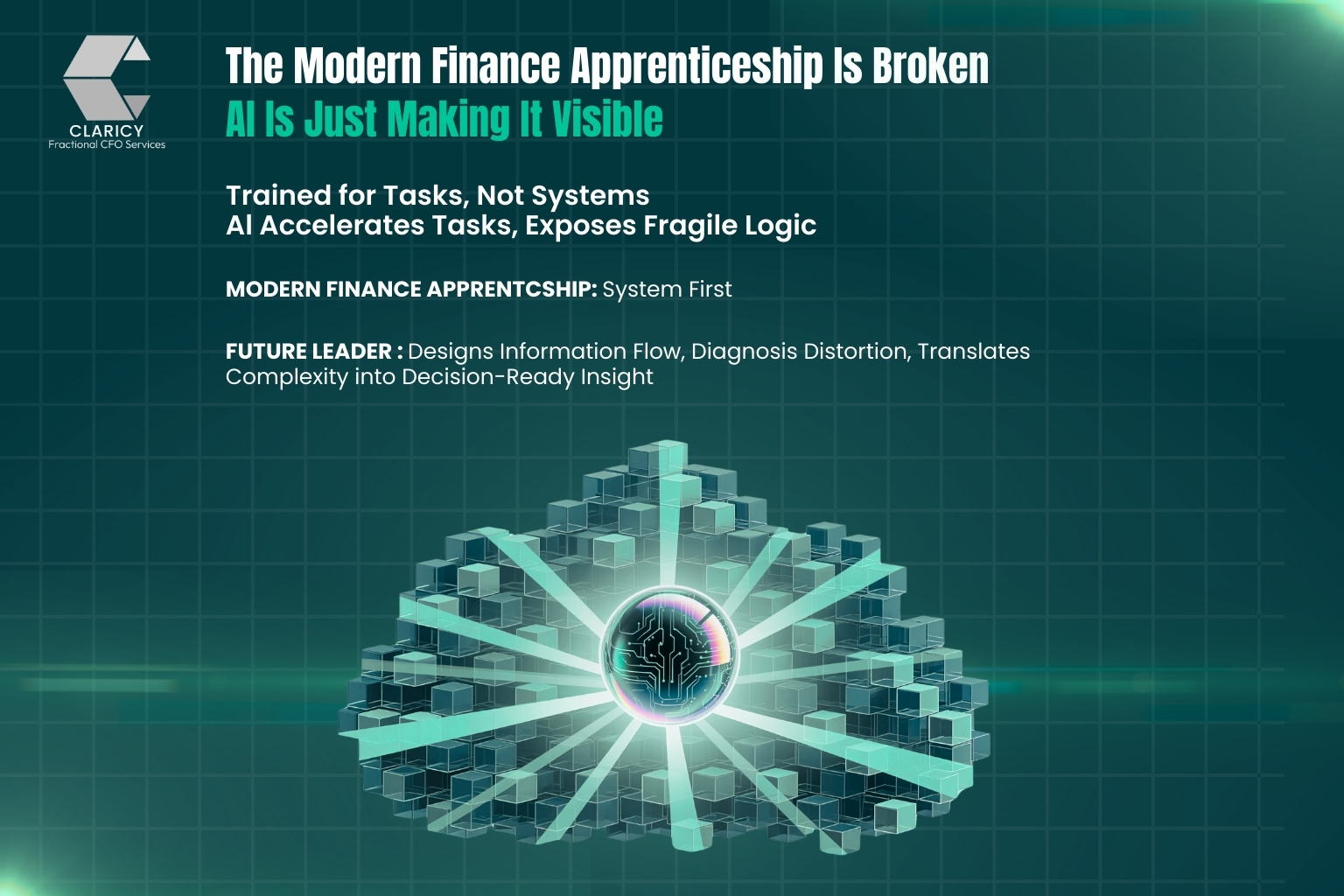
The modern finance apprenticeship is broken. AI isn’t causing the problem—it’s exposing the gaps in how finance talent is developed.
Most finance teams are not struggling because they lack talent.
They are struggling because they were trained for tasks, not systems.
Traditional finance apprenticeships taught people to:
Close the books
Reconcile accounts
Build forecasts
Produce reports
That model worked when businesses scaled slowly, and systems were relatively stable.
It no longer does.
Today's finance environment is de f ined by speed, tool sprawl, cross-functional dependencies, and Al-accelerated output.
In that context, task mastery is table stakes.
It is not leadership.
The real gap I see across SaaS and professional services teams is this: Finance professionals can execute flawlessly inside systems they do not fully understand.
They are rarely taught:
Where numbers actually originate
How assumptions quietly compound risk
Why information arrives late or distorted
What breaks first as volume, pricing, or delivery
models change; this is usually where teams are surprised
And, o f ten overlooked, which decision the output is even meant to support
So teams move faster, while leaders feel less clear.
Where this really starts to matter is with AΙ.
Al is excellent at accelerating tasks.
It is unforgiving when system understanding is weak.
Confident outputs built on fragile logic create the illusion of clarity, until decisions fail under pressure.
A modern finance apprenticeship must be systems-first.
It should train people to ask:
How does in formation actually flow through this
business?
What behaviours does this metric rein force?
What assumptions must hold true for this model to matter?
Where does judgment, not automation, belong?
The future finance leader is not the fastest producer of reports.
It is the person who can design information flow, diagnose distortion, and translate complexity into decision-ready insight.
That capability is learned, but only if we teach for it.
This is part of a broader series on how modern finance must be engineered as businesses scale, not patched later.