Explore the rise of the finance coordination function and how it improves financial alignment, efficiency, and strategic decision-making.
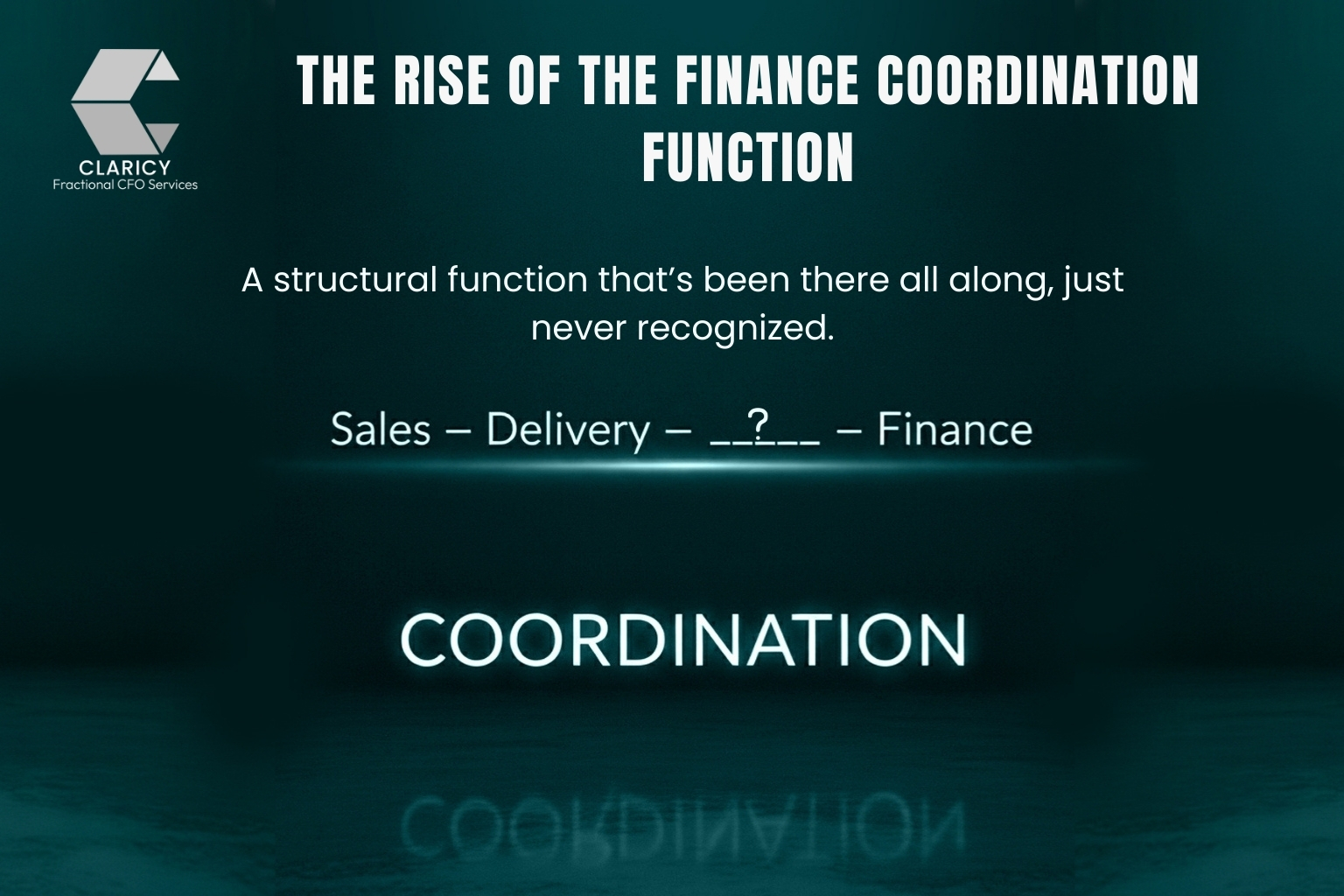
In most growing companies, finance feels like a relay race with no baton.
Sales hands off to delivery, delivery hands off to finance… And somewhere along the way, the baton drops.
When it does, the inefficiency doesn’t stay in finance; it ripples upward.
Delays. Rework. Decisions made with partial information. It feels exponential as the business grows.
The root cause isn’t accounting. It’s coordination.
Every SMB performs this work from day one, long before anyone names it.
Early on, the founder carries it instinctively: tracking commitments, cash, invoicing, what’s been done, and what’s at risk of slipping.
When they can’t carry it all, parts of it get passed to an admin or ops. At that stage, it’s usually basic transaction hand-offs and email chasing. It’s not real coordination; it’s survival.
As volume increases, the work doesn’t disappear; it fragments. A bit with admin. A bit with ops. A bit with the bookkeeper. Everyone holds a piece, but no one owns the flow.
And in SMBs, this function rarely gets recognized on its own. It surfaces only when something forces the issue: a finance unicorn leaves, an audit comes up, a renewal is missed, an ERP is being implemented, or a business leader finally says, “We can’t run this business or make decisions without a reliable, continuous flow of data.” Until then, the coordination layer stays invisible, and the symptoms show up everywhere else.
This is the finance coordination function. Not a new hire. A structural function that’s been there all along.
Its mandate is simple:
Keep information moving cleanly from sales → delivery → finance → decisions.
In practice, that means:
· Sales activity becomes accurate invoices
· Invoices become predictable cash
· Systems stay aligned
· Inconsistencies get caught early
· Operational activity flows cleanly into the numbers
· Finance has the inputs to produce clarity, not cleanup
When this function is intentional, the whole business changes: Business leaders get visibility without chasing updates. Finance leaders can focus on what matters. Cash forecasts stop feeling like guesswork. Reporting reflects reality.
Most finance failures appear to be people or technology issues. But in growing companies, the underlying cause is usually broken flow, and flow breaks when coordination is undefined or overloaded.
As automation and AI accelerate how data moves, this human layer becomes even more important. Tools can move data, but they can’t ensure continuity, context, or accountability.
In growing businesses, the ones that make the best decisions aren’t the ones with the fanciest dashboards.
They’re the ones with uninterrupted flow.